
Monster Hunter: The Field First Playthrough Guide
Monster Hunter: The Field First Playthrough Guide

First I want to go around!
“Monster Hunter The Field” is an attraction based on Capcom’s “Monster Hunter” and set in “Nijigen no Mori” on Awaji Island in Hyogo Prefecture.
This article is a strategy guide for those who are looking to complete one playthrough of “Monster Hunter: The Field” in order to get an overview of the game.
“Completing one playthrough” refers to successfully defeating the first large monster in “Monster Hunter: The Field,” a low-ranking Rathalos, and reaching the results screen.
This article will guide you through the following:
- Overview of “Monster Hunter: The Field”
- How to play “Monster Hunter: The Field”
- Monsters and weapon types that appear in “Monster Hunter: The Field”
- Efficient movement methods for each phase in “Monster Hunter: The Field”
- An explanation of the movements to watch out for of the large monster “Rathalos (lower rank)” in “Monster Hunter: The Field”
Overall flow of the attraction

The game consists of the following four steps, and you can expect each hunt to take approximately 40 minutes.
[1] Reception
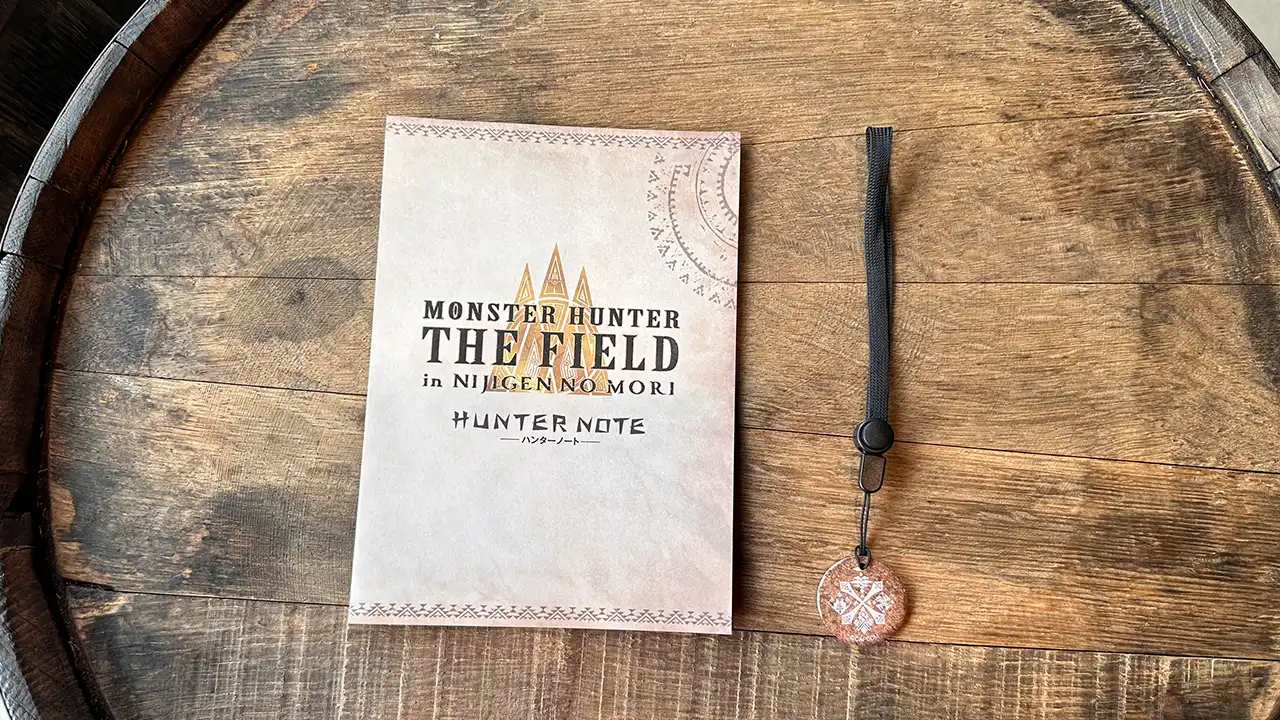
The Hunter’s Proof is an item that saves your data from the second playthrough onwards, so please make sure you do not lose it and keep it with you for your next challenge.
(Reissue is not possible)
[2] Field Exploration
This is the preparation phase for defeating large monsters. You can acquire up to three items, such as healing potions, and scout up to one Felyne Palico to help you defeat large monsters.
[3] Defeat large monsters

This is the phase where you defeat large monsters, which can be said to be the highlight of the “Monster Hunter” series. Since this is an article about “the first step,” in the first playthrough you can only fight a low-ranking Rathalos. From the second playthrough onwards, depending on your Hunter Rank (HR), you can also fight a high-ranking Rathalos or the new Zinogre, which will be introduced in the fall of 2024. Up to three people can take on the challenge at the same time.
[4] Check the results
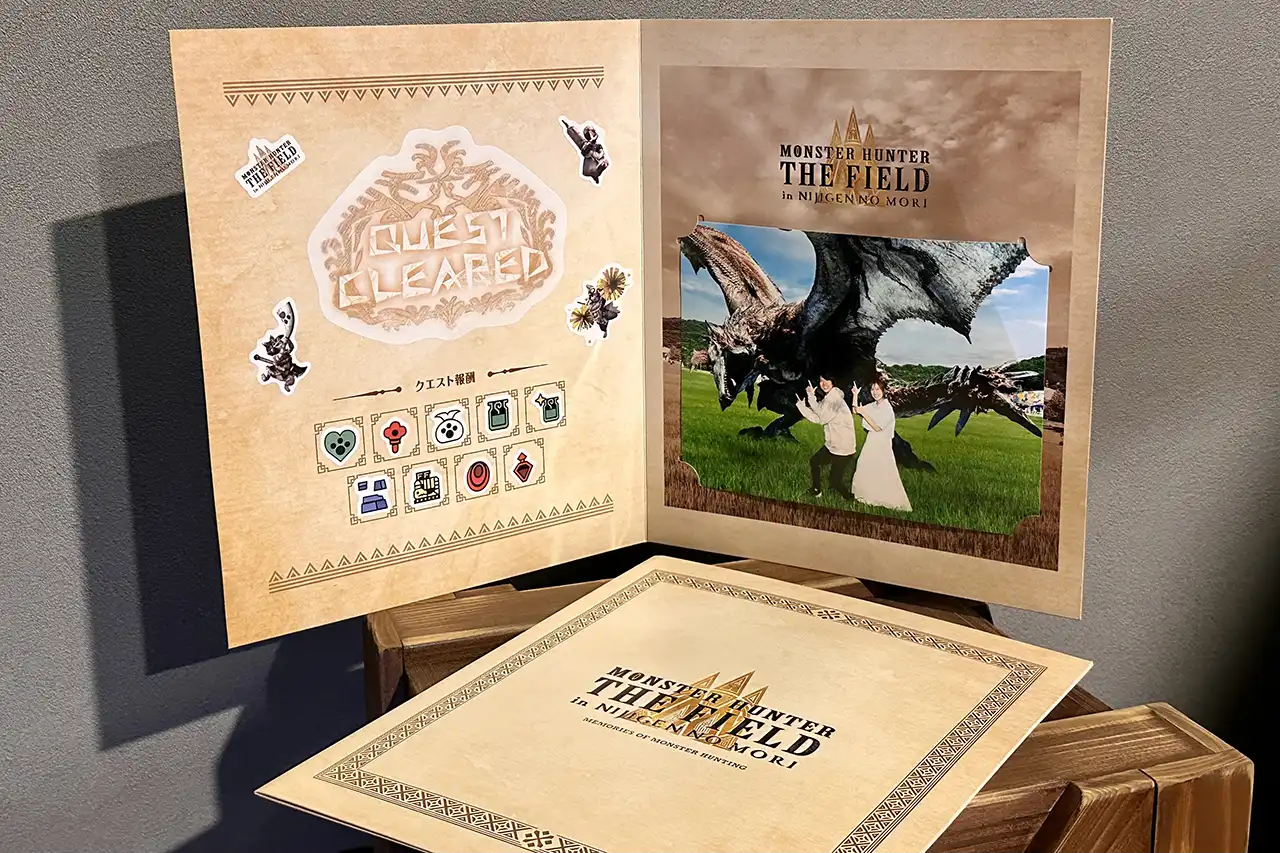
You can check the game results, including the results of defeating large monsters.
Your hunter skills are evaluated based on whether you succeed in defeating monsters, whether you succeed in avoiding large monsters when fighting them, and your remaining HP, and are displayed as a score.
Your score will also be reflected in your Hunter Rank. Your Hunter Rank will increase, and you may be able to choose more difficult monsters from your second playthrough onwards.
First- time hunter sign-up

There is no need to register any personal information. You will receive a Hunter’s Proof and Hunter’s Notebook and receive an initial briefing.
<PHASE 1> Exploring a field <PHASE 1> Field exploration flow

Discovery Overview
Search for item boxes scattered throughout Nijigen no Mori, find useful items, and prepare to defeat large monsters.
Exploration Type
| Scout Box Search | Palico | 3 |
|---|---|---|
| Item Box Search | Items used during the subjugation | 3 types |
| Settlement items | 5 types |
Exploration can be roughly divided into two types depending on the box you are searching for: “Scout Box” and “Item Box.”
Inside the Scout Box, you can find your Palico, who can help you defeat large monsters. They are a powerful companion who will support you in battle by healing you and increasing your defense power.
The item box contains a variety of items, including items that can be used when defeating enemies, such as recovery potions, and settlement items that are added to your score on the results screen. There are several types of each, so it’s a good idea to look around for them.
You can scout up to one Pokémon in the Scout Box, and open up to three Item Boxes to obtain their contents.
Once opened, the contents of either box cannot be discarded or exchanged for another item.
Exploration Tips
Both the scout box and item box are in a large box. The Hunter’s Notebook distributed at the reception desk will give you a rough guide to their locations, so please refer to it.
There is a possibility that some very powerful items may be hidden in the item boxes located far from the Awaji Gathering Hall where the reception is located. If you are confident in your stamina, it is a good idea to look for them.
PHASE 1 Clear and Game Over Conditions
The field exploration is completed when you open one scout box and three item boxes, and you cannot open any more boxes.
Also, please rest assured that there will be no enemy monsters or anything like that, so you won’t get a game over.
You can also go straight into defeating large monsters without exploring the field. If you haven’t scouted an Airou yet, this will be set automatically. Since you won’t get an item box, you won’t be able to obtain items that will give you an advantage in defeating large monsters.
<PHASE 2> Defeating a large monster <PHASE 2> Flow of defeating large monsters

Overview of the Expedition
Defeating large monsters is a phase where you select a monster and defeat it.

To defeat large monsters, players wear a weapon controller and tracking belt in a special room, and aim to successfully defeat the monster by swinging their arms to attack the monster or avoid its attacks.
Weapon types
In “Monster Hunter: The Field,” players can use four of the many weapons from the “Monster Hunter” series: Great Sword, Dual Blades, Hammer, and Light Bowgun. While the amount of damage received from large monsters remains the same for each weapon, the damage dealt and optimal strategies vary greatly depending on the weapon type, so choosing the right weapon is an important factor.
[1] Great Sword

This weapon has a huge blade, and is highly powerful and has a wide attack range. Among the melee weapons that appear in “Monster Hunter: The Field,” it has a good balance of attack power and speed, and combat requires skillful timing of attacking and dodging.
[2] Dual Swords

This weapon’s strength is its quick attacks, dealing multiple hits with a single swing. Because it leaves little room for attacking, the damage it deals is relatively modest, so you’ll need to maneuver around in a way that allows you to land multiple hits.
[3] Hammer

It is a high-powered melee weapon that can stun large monsters by attacking their heads. While there is a large gap before and after the attack, it is powerful to use the high damage and stun to launch a series of attacks in one go.
[4] Light Bowgun

In “Monster Hunter: The Field,” it is the only long-range weapon that can attack monsters from a distance. Since damage varies depending on the distance from a large monster when attacking, the key to victory will be to maintain a distance where you can deal the most damage.
Large monster introduction
As of September 2024, players can defeat both high-rank and low-rank Rathalos in Monster Hunter: The Field. As recently announced, players will be able to fight Zinogre during the Fall 2024 season.
[1] Rathalos

Saurischia, Sauropoda, Crustacea, Pterygoidea, Rioidae
Also known as the “fire dragon,” this flying dragon has large wings. In “Monster Hunter: The Field,” a low-ranking Rathalos stands before the player as the first obstacle they must face. Can you defeat Rathalos, avoiding its poisonous claws and the flames it spits from its mouth?
[2] Zinogre

Saurischia, Tetrapoda, Ophiuroidea, and Zinogrestoidea
Also known as the “Thunder Wolf Wyvern,” this large monster has enormous limbs and can freely control electrical energy. Starting in the fall of 2024, you’ll be able to challenge it as the second formidable enemy in “Monster Hunter: The Field.” Can you defeat its agile movements, unleashing its claws and surging electrical energy?
Combat Tips
[Find the optimal location and distance]
“Monster Hunter: The Field” is an action game that requires players to use their entire body to defeat large monsters.
When defeating large monsters, the battle room is divided into 9 squares, 3 squares in front, back, left and right, and attacks and evasions are judged by the division.

Large monsters have multiple attack motions, and the safe places to avoid them and the dangerous places to get hit depend on the attack motion.
The attacks of large monsters are very powerful, and in the case of the first Rathalos (low-rank), even normal attacks will reduce the player’s HP to 0 if they are hit about five times.
For this reason, avoiding attacks from large monsters is essential in battle.
The most important point in defeating large monsters is to determine their movements and retreat to an appropriate location during battle.
Positioning is also very important when attacking from your side.
Large monsters are also constantly on the move, and tend to take up two positions: in front and behind.
Depending on the position of the large monster, your attacks may miss, so it is important to watch the large monster carefully and attack accordingly.
Furthermore, for close-range weapons, if the player is three squares in front, the weapon’s attack power will increase (a fixed increase). Especially on the first playthrough, when the player’s base attack power is low, the percentage increase in attack power when the player is in the front is large, so when playing through the first playthrough, waiting for an opening when a large monster is about to appear and moving forward is a very effective tactic for increasing damage. However, if you stay in the front, you will be unable to avoid being hit by the large monster’s close-range attacks, so you will need to distance yourself at the right time.
When using a light bowgun, a long-range weapon, the distance is calculated based on the position of your opponent and your own position. The damage dealt by the light bowgun changes depending on this distance. The key to winning with a light bowgun is to keep an eye on both sides’ positions, maintain an appropriate distance, and deal large amounts of damage.
[Emphasis on evasion: Player HP and number of revivals]
The player’s HP is fixed at 1000, and unlike the regular series, “Monster Hunter: The Field” does not have any armor, so there are limited ways to reduce damage. While reduced HP can be restored with recovery potions, the number available is limited, and in some cases, you may be defeated without any recovery potions. There is also no invincible motion like an emergency evasion, so you will need to play in a way that does not take damage.
If your HP still runs out, your entire party can revive up to two times. Please note that if someone runs out of strength on the third try, the defeat will be failed.
There are two main ways to recover HP. You can use recovery items (Recovery Potions/Great Recovery Potions) from your item box, or you can ask for the help of your Palico “Healer.” Both can be found during the field exploration phase, so be sure to look for them on your first playthrough so you can get some help.
PHASE2 Clear and Game Over Conditions
Regardless of the outcome of defeating a large monster, you will proceed to the final results. There is no game over or continue option. If you really want to say, as mentioned above, “the entire party running out of energy three times” is a condition for failure. There is also a time limit for defeating large monsters. For a low-ranking Rathalos, it is 120 seconds. Avoiding the attacks of large monsters is essential to defeating them, but if you only avoid them, you will run out of time and fail, so attacking when you see an opening is also necessary for a successful defeat.
Result What happens after defeating a large monster? (How to end or continue?)
Flow from the second round onwards
Regardless of the outcome of defeating the large monster, the player will proceed to the results screen and the game will end.
Players who have finished the game can bring their previous Hunter’s Proof the next time they play Monster Hunter: The Field, allowing them to continue playing from their second playthrough onwards, carrying over their previous playthrough results.
There are three major benefits to playing the game a second time or later.
The first is to carry over your previous Hunter Rank (HR). If your Hunter Rank has increased in the previous result, you can choose a new opponent for defeating large monsters.
“Zinogre,” which will be implemented in the fall of 2024, can be challenged from Hunter Rank 2.
The second is that the weapon’s attack power may increase. The condition is to select the same weapon as in the previous play. If you select a weapon you have used once before, the weapon’s attack power will be permanently increased up to two times (fixed value: total of three levels).
If you choose a weapon you have never used before on your second playthrough or later, your attack power will not increase.
The third and final element is experience points gained from exploring the field. In Monster Hunter: The Field, the locations of items are fixed unless otherwise announced by Nijigen no Mori, so from the second playthrough onwards, you can start with some of the item locations already known.
This will make it easier to find the items you want, giving you a greater advantage in defeating large monsters.
Beginner’s guideRecommended for beginners (for those who want to successfully defeat the monster for the first time)
Recommended actions when exploring the field
Be sure to explore the field thoroughly. What you’ll want especially on your first playthrough is recovery medicine. Since the attack motions of large monsters are unknown, the more recovery medicines you have, which increase the number of times you’ll be hit, the more secure you’ll be. Item-related items cannot be used when defeating large monsters, so you can lower their priority.
There are two types of recovery potions you can pick up: regular recovery potions and great recovery potions. If you’re looking for a higher-level item, it might be a good idea to go a little further and look for an item box further away.
Recommended weapons for hunting
Monster Hunter: The Field is balanced so that you can successfully defeat monsters using your preferred weapon. If I had to choose just one weapon for beginners, I would recommend the light bowgun. This is because it has the lowest risk of being hit.
Of the weapons in “Monster Hunter: The Field,” the three melee weapons deal increased damage, so you’ll need to time your attacks by moving to the front row. However, it can be difficult to avoid attacks from large monsters in the front row, and you’re more likely to take damage.
The only weapon that doesn’t require you to be in the front row when aiming for maximum damage is the light bowgun, which is relatively easy to avoid. Therefore, the light bowgun, which makes it easy to fight a “battle you can’t lose,” is recommended for beginners.
Furthermore, even if three players with light bowguns take on the Rathalos (low rank), they can still easily defeat it. Evading attacks in the battlefield is also possible, so there’s no need to force yourself to use different weapon types.
However, melee weapons have advantages over light bowguns in exchange for the higher damage risk. For example, the hammer’s stun ability and high attack power, the dual swords’ multiple attacks, and the greatsword’s wide attack range make them more powerful than light bowguns.
Especially from the second playthrough onwards, choosing the same weapon will increase the weapon’s attack power, so it’s perfectly fine to choose a melee weapon from the start in anticipation of the second playthrough. However, if you’re someone who’s somewhat familiar with hunting in the Monster Hunter series, there’s no problem with using your favourite weapon.
Key points for fighting Rathalos (low rank)
For the first playthrough, which is the target of this article, the common target for all players is the low-ranking Rathalos.
Although it is the first monster, Rathalos (lower rank) is a very formidable opponent. When fighting Rathalos, also known as the “Fire Dragon,” the thing you need to be most careful of is the flame attack from its mouth.
Even in Monster Hunter: The Field, this attack is difficult to avoid, and it will unleash a fire attack regardless of your position. You must always pay attention to the facial movements of a low-ranking Rathalos when hunting it.
PostscriptFinally
The large monsters in “Monster Hunter: The Field” are quite formidable, even the first Rathalos (low-ranked). Avoid its fire attacks and you’ll be sure to defeat it successfully.
Once you reach Hunter Rank 2, you will be able to choose to hunt down Zinogre, which is scheduled to be implemented in the fall. Please give it a try!


